


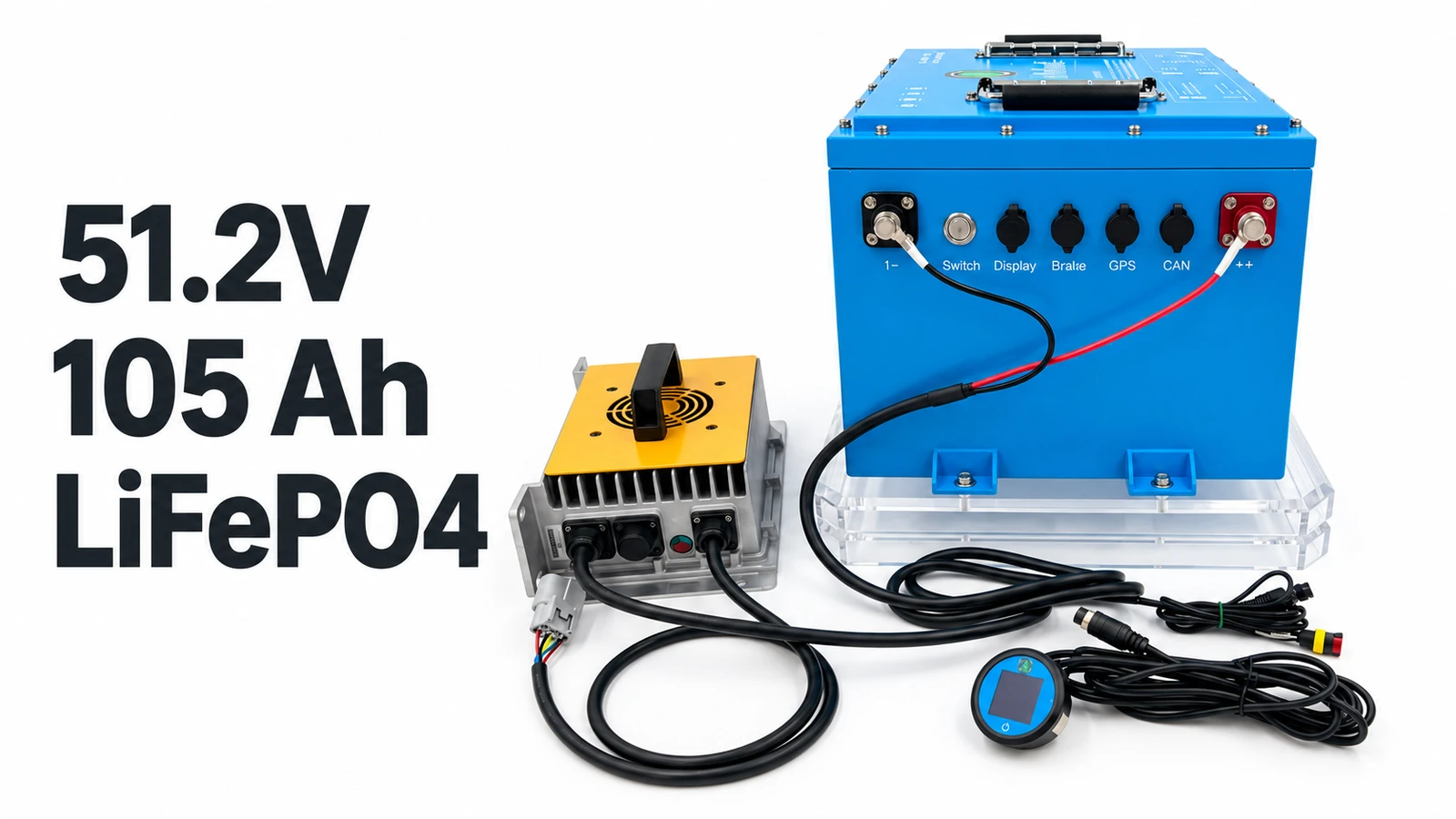
5.4 kWh
105 Ah
US$2,200.00
35 km / 21.7 mi
Reference at 3,000 RPM · KleverWheels measured
- 58.4V / 22A charger and display included
- Battery warranty: 5 years from sale
KleverWheels · Buying & ownership guide
37 answers about golf cart LiFePO4 battery compatibility, real-world range and care in the Dominican Republic.
Reviewed October 18, 2026 · 105Ah / 150Ah / 168Ah
51.2V · LiFePO4
Three capacities. One complete kit. Choose for your daily route.
Check compatibility on WhatsApp →
5.4 kWh
US$2,200.00
35 km / 21.7 mi
Reference at 3,000 RPM · KleverWheels measured
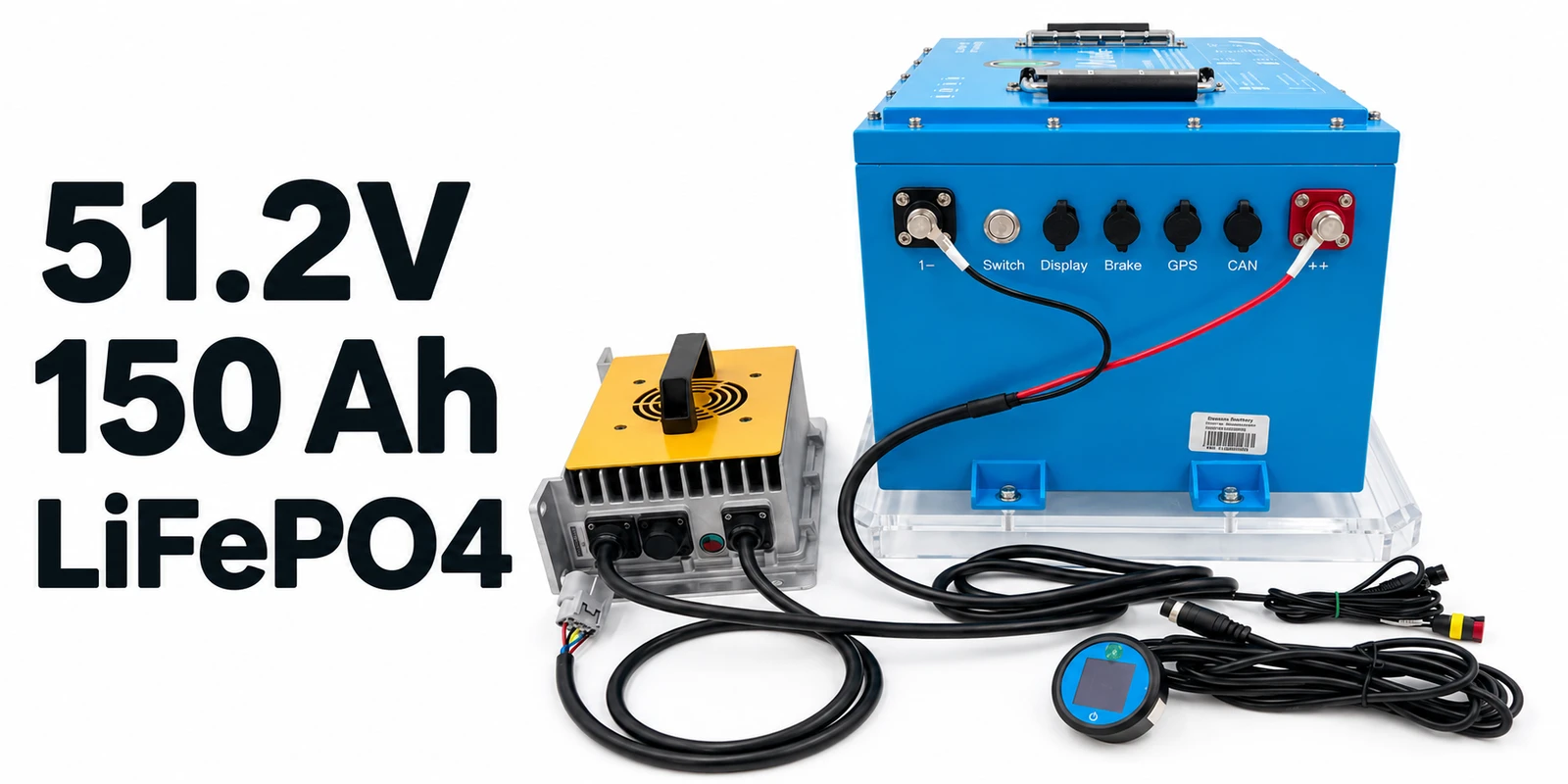
7.7 kWh
US$2,600.00
50 km / 31.1 mi
Reference at 3,000 RPM · KleverWheels measured
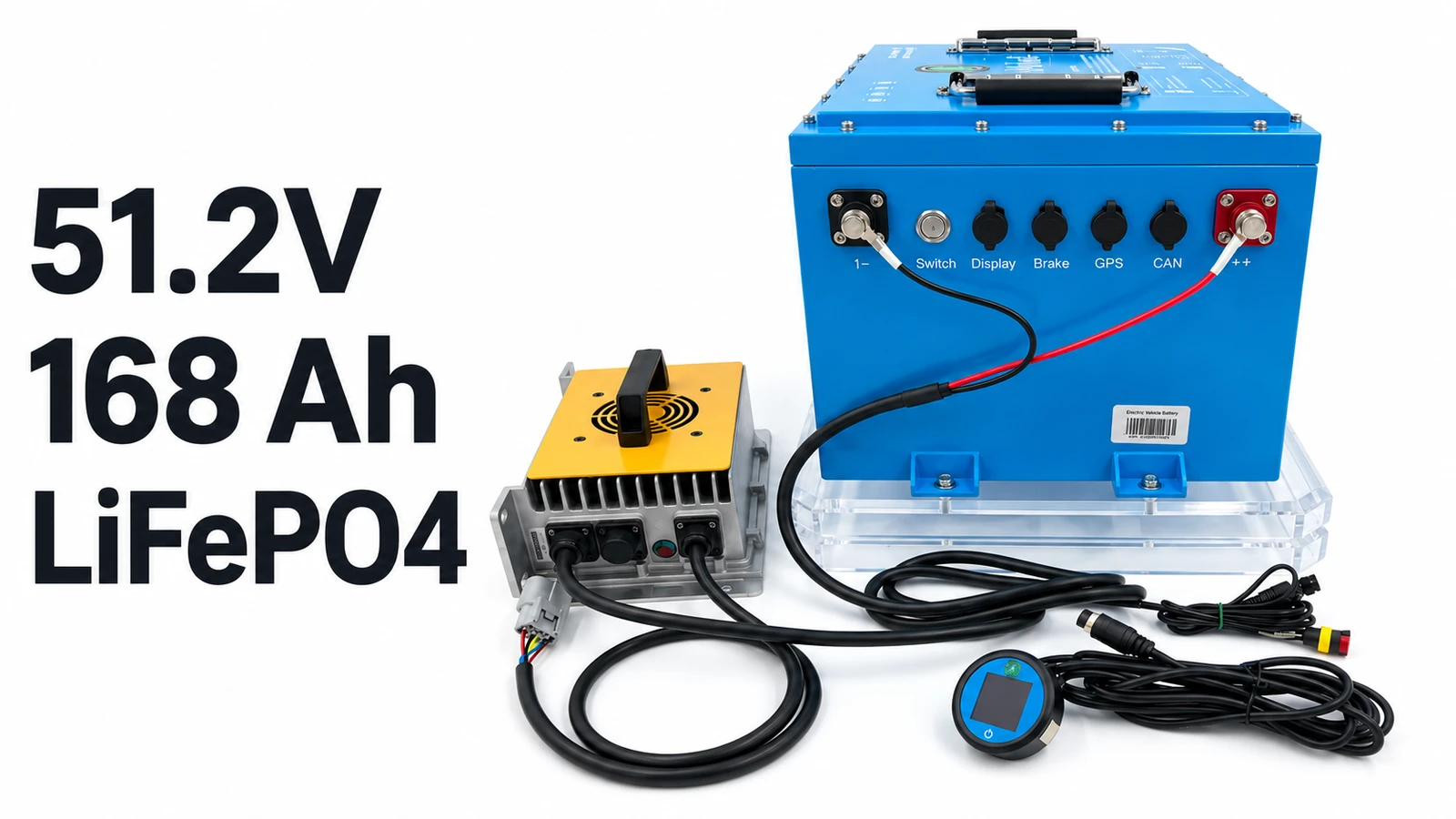
8.6 kWh
US$2,800.00
56 km / 34.8 mi
Reference at 3,000 RPM · Proportional estimate
A transparent comparison
3,000 RPM: 25 km/h (15.5 mph) on the reference cart.
Measured reference
Measured reference
168Ah: proportional estimate
KleverWheels real-world reference figures: flat terrain, four passengers in a four-seat cart, battery used from 100% to 20%. The 168Ah figures are proportional estimates based on 150Ah testing. Actual range varies. AWD configurations may provide approximately 30% less range.
Terrain, tires, occupants, driving habits, drivetrain and battery age affect range. A six-seat cart may use approximately 20% more energy than a comparable four-seat cart. These are not guaranteed distances.
KleverWheels 51.2V LiFePO4 batteries are designed for many electric golf carts with a nominal 48V system, including compatible Club Car, EZGO, Yamaha and other models. Compatibility depends on the controller, wiring, charging system, battery compartment and any vehicle-specific electronics. Tell us your golf cart's make, model and year so we can confirm before purchase.
Yes. A correctly selected 51.2V battery can replace a conventional 48V lead-acid set, such as six 8V batteries or four 12V batteries. The conversion reduces weight and routine maintenance and eliminates distilled-water refills. Check vehicle and electrical compatibility first.
Qualified owners familiar with high-current DC electrical systems may be able to install it, but we recommend professional installation to verify polarity, cables, mounting, fuse protection, controller compatibility and charger operation. Installation is separate from the standard kit.
Most compatible standard 48V carts do not need a new motor controller. Certain carts, especially those with regenerative braking, proprietary battery communications or modified high-power systems, may require additional assessment or adjustment. Verify before installation.
Compare the published model dimensions with the available space, allowing for mounting brackets, terminals and cable routing. Compartments vary by cart. If unsure, send us compartment photos and measurements. The 150Ah and 168Ah models share the same stated dimensions: 650 × 312 × 265 mm.
Usually the entire wiring system does not need replacement. However, power cables, connectors and protection devices should be inspected to make sure they handle the operating current. Correct any damage, corrosion or undersized wiring before use.
We prefer realistic operating figures over ideal marketing claims. On flat terrain with four passengers in a four-seat cart, discharging from 100% to 20%: at about 25 km/h (15.5 mph), approximately 3,000 motor RPM, the 105Ah delivers 35 km (21.7 mi), 150Ah 50 km (31.1 mi) and 168Ah an estimated 56 km (34.8 mi). At the higher operating regime of approximately 5,000 motor RPM, figures are 25 km (15.5 mi), 35 km (21.7 mi) and an estimated 39.2 km (24.4 mi) respectively. The 168Ah results are proportional estimates derived from 150Ah operating data. AWD may reduce range by approximately 30%. Speed, terrain, passengers, vehicle efficiency and battery condition all affect actual range.
Select capacity for your actual daily driving, not simply the largest battery. KleverWheels recommends a capacity allowing at least one normal day and ideally no more than about three days between full charges. Oversizing a battery to charge only every 7–10 days can make the BMS's remaining-charge estimate less accurate. Repeated partial charges and prolonged storage without a fresh charge can cause SOC estimation drift; the display may overestimate the remaining energy and protection may eventually stop the cart. Choose the model that covers your normal route comfortably and allows periodic complete charges.
Yes, if electrically compatible and able to deliver the required current. Seating capacity alone does not determine battery size. Under comparable conditions, a six-passenger cart may use approximately 20% more energy than a similar four-seat cart; daily distance, load and charging routine should drive the choice between 105Ah, 150Ah and 168Ah.
It may improve acceleration and keep performance more consistent as the battery discharges, especially compared with worn lead-acid batteries. Maximum speed mostly depends on the motor, controller and vehicle settings. A battery swap does not guarantee higher top speed.
LiFePO4 generally maintains a more stable voltage under load and weighs less than an equivalent lead-acid set. This can improve performance consistency on inclines. Actual climbing power also depends on the motor, controller, gearing, tires, passenger load and battery current rating.
The standard kit includes a universal 58.4V / 22A LiFePO4 charger for 110–220V AC. Approximate times from 20% to 100% are 105Ah: 4–5 hours; 150Ah: 6–7 hours; 168Ah: 7–8 hours. We recommend a properly installed 220V outlet when available. KleverWheels field measurements found approximately 10% faster charging at 220V than 110V, while the reduced input current lowers stress on plugs, sockets and properly rated extension leads. Always use grounded, appropriately rated wiring; actual charging time varies.
Yes. LiFePO4 has no memory effect, so you can charge without first fully discharging it. However, avoid bringing a battery to 100% only to leave it unused for a long time. Ideally complete a full charge when you expect to drive the following day, rather than storing it full.
Yes. The supplied compatible automatic charger is designed to complete the charging cycle and stop according to its charging controls. Overnight connection is permitted under normal conditions. Keep it ventilated, use a properly installed outlet and do not cover it or use damaged cables.
Only as a temporary emergency option if KleverWheels has confirmed the specific charger is electrically compatible. Many lead-acid chargers terminate at a voltage that leaves a lithium battery short of full stored energy, even if a display reads 100%. Other chargers have voltage or equalization modes unsuitable for lithium. Do not use an unapproved charger regularly. Incorrect charging can cause performance or BMS problems and may affect warranty eligibility under the written terms. The supplied lithium charger is the recommended choice.
No. Fully discharging is neither required nor recommended as a routine. Partial top-ups are acceptable, although periodic complete charges according to the manual help keep some BMS charge estimates accurate. Avoid repeatedly reaching protection cutoff.
KleverWheels 105Ah, 150Ah and 168Ah models have a declared 4,000-cycle rating. Actual service life in years depends on heat, storage, depth of discharge and charging habits. This cycle-life rating does not guarantee a fixed number of calendar years or an unverified remaining-capacity percentage.
One equivalent full cycle means using energy equal to the battery's rated capacity. For example, two uses of about 50% each total approximately one full equivalent cycle. The battery does not automatically stop functioning at cycle 4,000; capacity generally declines gradually. End-of-life capacity depends on the manufacturer's test method.
The Battery Management System monitors cell voltages, current, temperatures and other safety parameters. It helps protect against overcharge, deep discharge, excess current and overheating; it also estimates SOC and may balance cells. BMS protection must never be bypassed.
A shutdown may follow low cell voltage, high current, heat, bad connections or another BMS protection trigger. A common additional concern is SOC estimation drift: after a full charge followed by long disuse without refreshing the charge, or after many partial charges without a true full-charge reference, the display may no longer reflect remaining energy accurately. The battery may hit its protective low-voltage limit while the gauge still suggests usable charge. Have the system checked and do not bypass protection.
No, not reliably. Lead-acid voltage-based gauges use different voltage/SOC behavior and are not appropriate indicators of LiFePO4 remaining charge. Use the lithium-compatible display supplied with the kit. Even a proper BMS may occasionally need SOC calibration.
The BMS may prevent normal charging after a critical low-voltage event to protect the cells. Recovery requires diagnosis and a procedure approved for that specific BMS. Never connect another battery directly, force charging with improvised equipment or bypass protection. Contact KleverWheels support.
Sometimes. Regenerative braking sends energy back to the battery. A nearly full battery or charging current beyond permitted limits may trigger protection. Confirm compatibility between vehicle controller, regenerative braking and battery before fitting the kit, especially in modified carts.
Only if the manufacturer expressly permits that specific series or parallel arrangement. Separate BMS units are not automatically compatible. Incorrect connections may cause excessive currents, trips or damage. Ask KleverWheels before combining packs.
Potentially, provided the pack supports the system's required continuous and peak current. High-performance controllers may demand more than a standard cart. Ask for a compatibility assessment before connecting a modified drivetrain.
Generally yes, provided the battery remains within its specified temperature limits. Do not install it in a poorly ventilated compartment that traps heat or expose it to excessive direct solar heating. Correct installation and ventilation matter for reliability, life and safety.
Yes, when the battery, connectors and installation provide appropriate water protection. Normal rain is not the same as immersion or a pressurized water jet. Check the particular model's declared IP rating and avoid exposed electrical contacts.
Salty coastal air accelerates corrosion of exposed connectors, terminals and other metals. Inspect and maintain external connections regularly, particularly in Punta Cana, Cap Cana, Casa de Campo and other coastal communities.
No. Unlike flooded lead-acid batteries, LiFePO4 batteries do not need water topping-up. Routine care focuses on proper charging, clean secure connections, suitable temperatures and periodic inspection.
Store the battery at approximately 50–70% SOC, then switch it off using the power button on the battery itself. Keep the vehicle in a shaded, dry, ventilated place and check the battery periodically according to the manual. Before returning to service, inspect and charge it appropriately.
LiFePO4 generally offers greater thermal stability than common nickel-rich lithium-ion chemistries such as NMC. Controlled lab comparisons of certain cell/module designs show slower thermal-runaway propagation for LFP; that does not establish a specific real-world reduction in fire probability for KleverWheels packs. Our batteries include BMS protection, but no powerful battery is completely risk-free. Correct installation and charging are essential.
An intact battery enclosure may be cleaned gently with water and mild soap or car shampoo when electrical connections are properly protected. Do not use high-pressure washers, aggressive detergents, solvents, immersion or spray into connectors or damaged seals. Follow the model-specific cleaning instructions.
Lithium has a higher initial price but offers lower weight, generally longer cycle life, steadier performance and much less routine servicing. There is no water to add, and correctly used LiFePO4 tolerates partial charging better than flooded lead-acid technology. Lifetime cost may be lower despite the higher purchase price.
In a representative comparison, a lithium pack can cost roughly twice as much as a comparable lead-acid setup yet last around five times as long. Such a scenario greatly reduces replacement cost over time, but actual savings depend on product quality, usage and local prices. Lead-acid batteries can fail even in seldom-driven carts because storage-related self-discharge and sulfation accelerate deterioration without adequate charging. LiFePO4 longevity is more closely associated with cycling, while also depending on calendar age and temperature.
The KleverWheels 105Ah, 150Ah and 168Ah batteries carry a five-year battery warranty from sale, subject to the applicable written policy. Incorrect installation, incompatible chargers, unauthorized modifications and use outside permitted limits may affect coverage as defined in that policy. Review the actual warranty document for conditions and exclusions.
The standard kit includes one 51.2V LiFePO4 battery in your selected capacity (105Ah, 150Ah or 168Ah), one universal compatible 58.4V / 22A charger (110–220V AC) and one lithium-compatible charge display. Professional installation and GPS tracking, where offered, are separate options. Confirm final contents before checkout.
KleverWheels supplies lithium battery kits in the Dominican Republic, with support in the La Romana, Punta Cana, Cap Cana and Casa de Campo areas, subject to current service availability. Contact us through our site's verified WhatsApp or sales channel with your golf cart make and model to confirm fit, delivery, price and installation options.
Battery delivery in La Romana and La Altagracia is free only when installation is ordered. Installation is charged separately at the listed price. Delivery without installation is quoted individually. In other regions, delivery is an additional charge quoted individually, including when installation is ordered. In-stock products are delivered in 3 business days. Delivery timing for products not in stock is agreed individually.